 Build AI CV
What Canadians call it
In Canada, the usual word is "resume". Some government pages also say a résumé is known as a curriculum vitae or CV. Employers mean the same document.
Keep it short and easy to read. Job Bank, the Government of Canada job site, gives this advice:
- No more than 2 pages.
- Cut out or shorten jobs that are more than 15 years old.
- Put your name and contact details at the top of the first page.
- Use simple, plain language and short bullet points.
What to leave out
Why? Human rights laws protect job applicants. For example, the Ontario Human Rights Commission says application forms should not ask about age (other than whether you are 18 or over) or marital status, and that employers should not ask for photos. Other provinces have their own human rights laws.
- No photo. Job Bank says a photo is not the norm in Canada and can even lower your chances.
- No personal details such as age, weight, height, marital status, religion or political views.
- Never your Social Insurance Number (SIN).
Your right to work (in general)
In Ontario, the only question about this that employers should ask at the application stage is: "Are you legally entitled to work in Canada?"
If you live outside Canada, Job Bank says your resume should show your name, where you live, your work experience and whether you have a valid Canadian work permit. It also says to apply only to jobs that are open to international candidates. On Job Bank, these jobs are clearly marked.
For work permits, use the official Immigration, Refugees and Citizenship Canada (IRCC) website only.
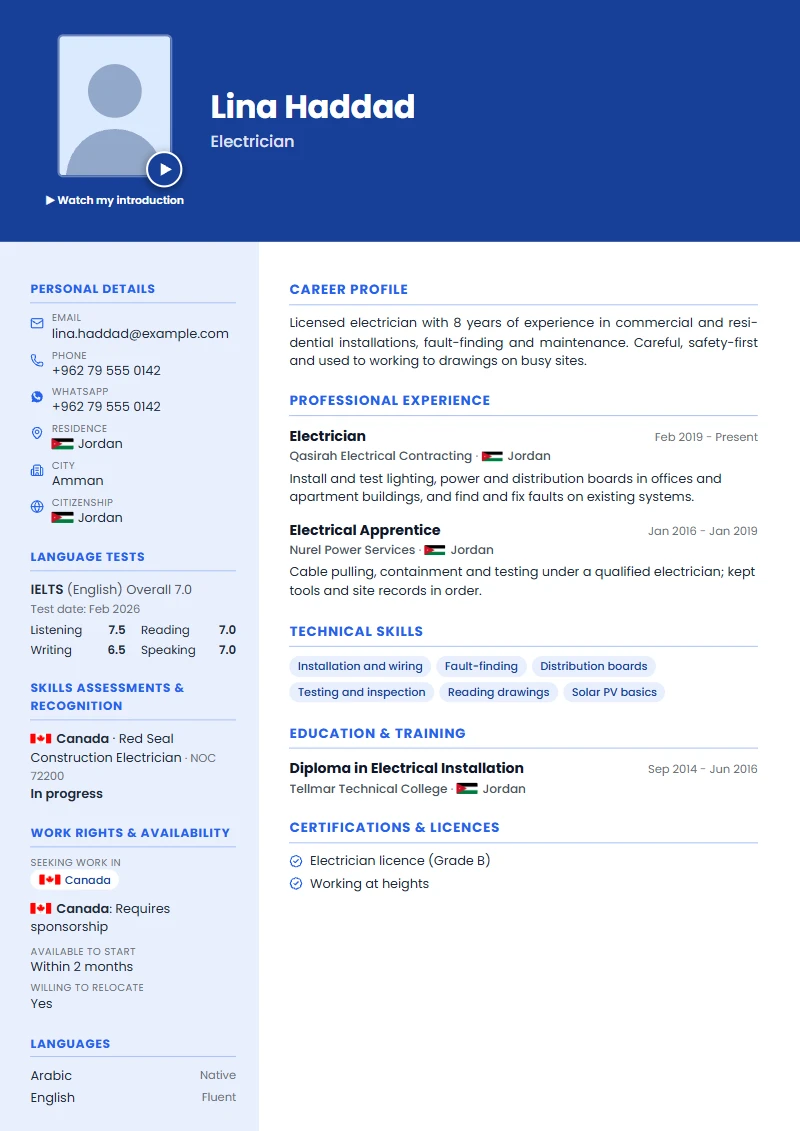
CV tip: Add one honest line near the top, for example "Legally entitled to work in Canada", "Open work permit, valid to [month, year]" or "Living in [country], no Canadian work permit yet". Write only what is true for you.
Work experience
Canada's National Occupational Classification (NOC) describes each job and its main duties. Search it for your job title to see the Canadian name for your work and the duties employers expect.
- Change your resume for each job ad. Put the most relevant experience first.
- Show achievements, not only duties. Your duties are often clear from your job title.
- Use strong verbs such as handled, managed, led, developed or increased.
- Add volunteer work if it is relevant or with a well-known organization.
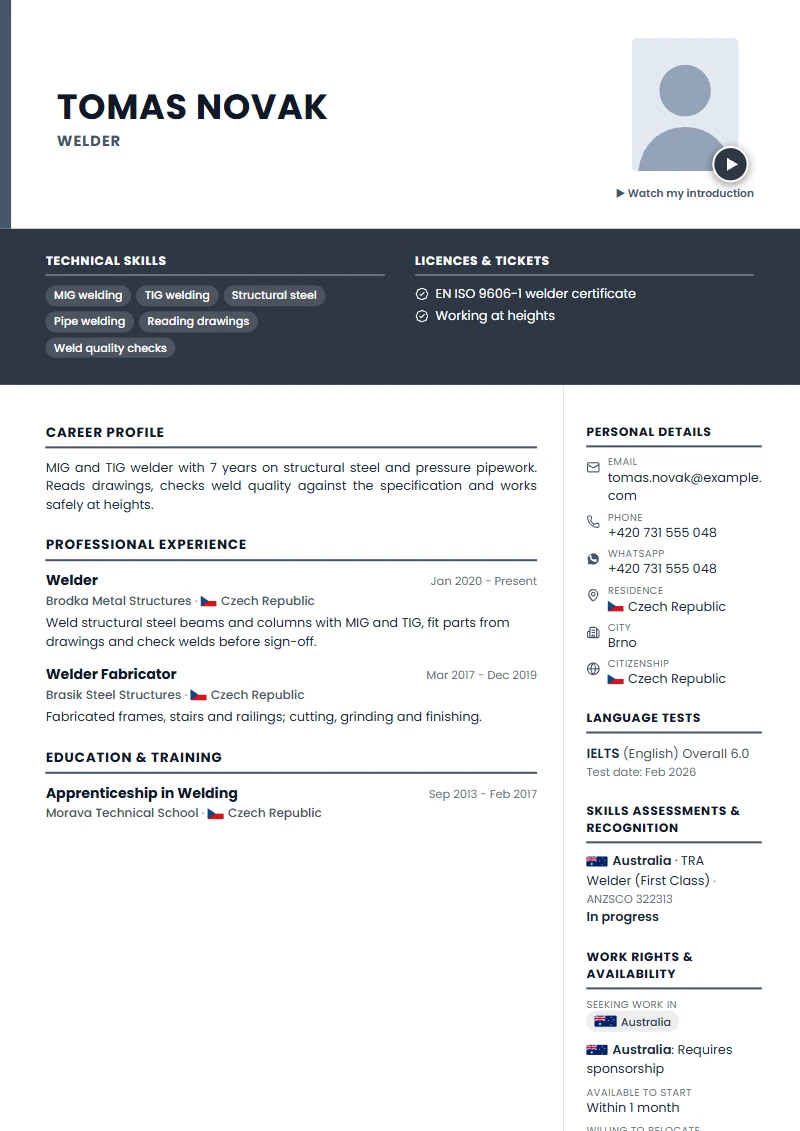
CV tip: If your past job title is different from the usual Canadian name for that work, keep your real title and add the Canadian name in brackets, for example "Fabricator (Welder)".
Trades: certificates, Red Seal and compulsory trades
In Canada, each province and territory runs its own trade training and certification. The Red Seal on a provincial or territorial trade certificate shows that you met the national standard for that trade.
Some trades are compulsory in one province and not in another. In a compulsory trade you must hold a certificate (or be a registered apprentice) to work. For example, Ontario's compulsory trades include plumber and electrician.
If you trained and worked abroad, you can often have your experience assessed and then challenge the certification exam. Ontario (Trade Equivalency Assessment) and British Columbia (the challenge process) are two examples. Check the trade authority in the province where you want to work.
CV tip: List each certificate exactly as it is written, with who issued it, the province or country and the year. If you are working towards one, write "in progress". Never claim a Canadian certificate or Red Seal that you do not hold.
Regulated professions: nurses, engineers and others
Some jobs in Canada are regulated. To work in them, or to use the job title, you need a licence or certificate from the regulator in your province or territory. The Government of Canada says to learn the process for your job and start it as early as possible, before you arrive in Canada.
Nurses: for most provinces, the National Nursing Assessment Service (NNAS) is the first step for nurses educated outside Canada (registered nurses, licensed practical nurses and registered psychiatric nurses). Quebec and the territories work differently.
Engineers: only people licensed by the engineering regulator in that province or territory may call themselves an engineer. Engineers Canada says claiming to be an engineer without a licence is against the law.
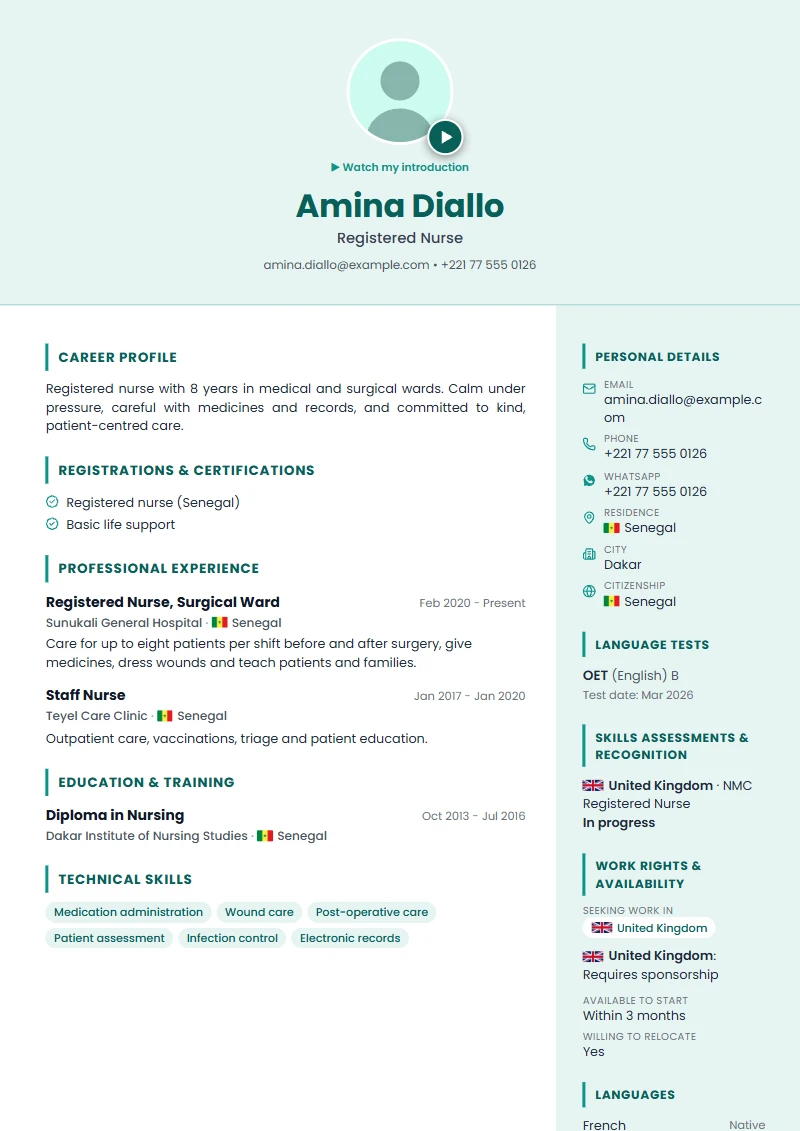
CV tip: Show your licence status in one clear line, for example "Registered Nurse (Philippines), NNAS application in progress" or "Engineering graduate (licence in progress)". If a past job abroad had "engineer" in its title, add the country next to it. If you are unsure, ask the regulator in your province.
Education and languages
Job Bank says a degree from another country needs to be assessed to check whether it is recognized in Canada.
List the languages you speak. If you took a language test for immigration, IRCC lists the accepted tests on its website (we only link to it, because the list can change).
CV tip: Write the qualification name as it appears on your certificate, the school, the country and the year. If your education has been assessed in Canada, add a short line about it.
References, cover letter and final checks
- References: keep them on a separate sheet. Employers usually ask for them only when they are seriously thinking of hiring you.
- Cover letter: short, well written and made for each company and job.
- Proofread your resume several times, and ask someone else to check it too.
- Use Canadian spelling. It usually follows British spelling in words like "colour" and "centre".
Watch out for job scams
- Be careful if the pay for a job seems too high to be real.
- Do not pay for offers of guaranteed entry into Canada or faster processing. The Government of Canada says these claims are false.