 Build AI CV
CV or resume?
In Australia, people usually say "resume". Many employers use "resume" and "CV" for the same document, so either word is fine.
- Keep it simple and professional, with a font that is easy to read.
- Save it in a common format, such as PDF or DOCX.
- Use Australian English spelling.
CV tip: Australian spelling uses "organise", "licence" (the noun) and "labour". Check your spelling before you send your resume.
How long should it be?
About 2 pages is the usual guide. It can be shorter or longer, depending on your experience.
Some employers set their own limit. For example, one government employer asks for no more than four pages.
CV tip: Put what matters most for this job near the top: your trade or job title, your key skills and your licences.
What to include
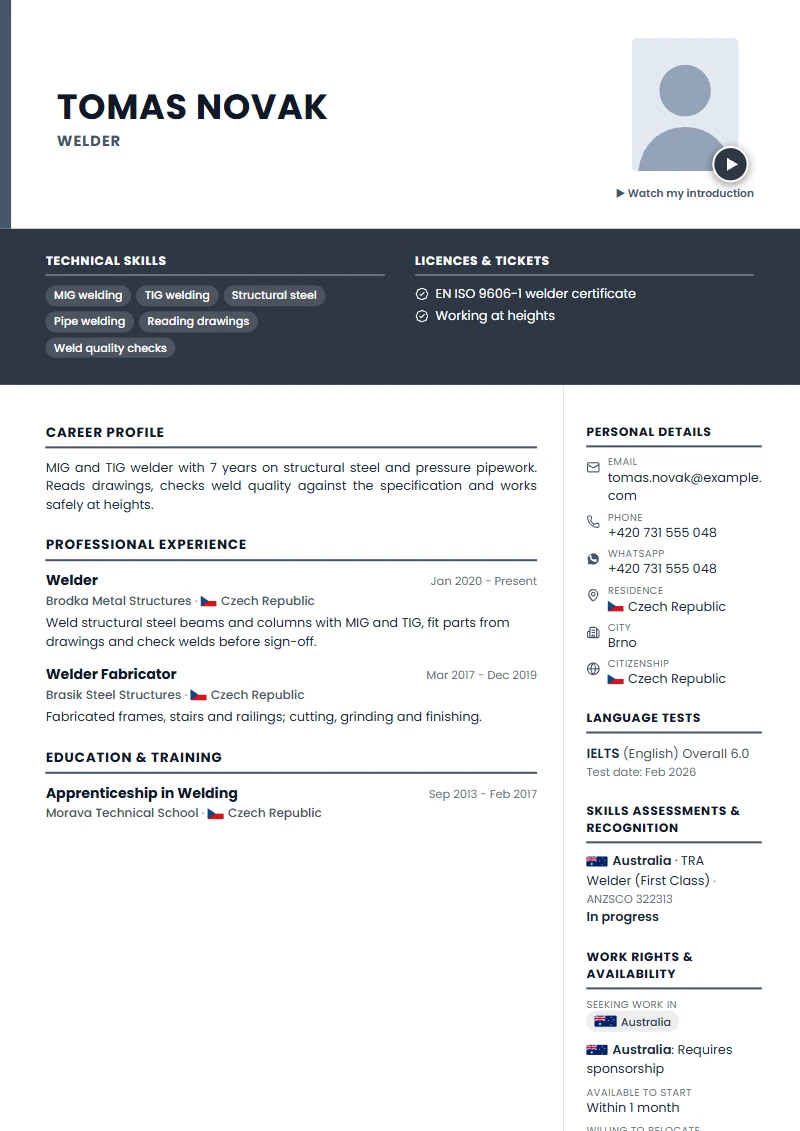
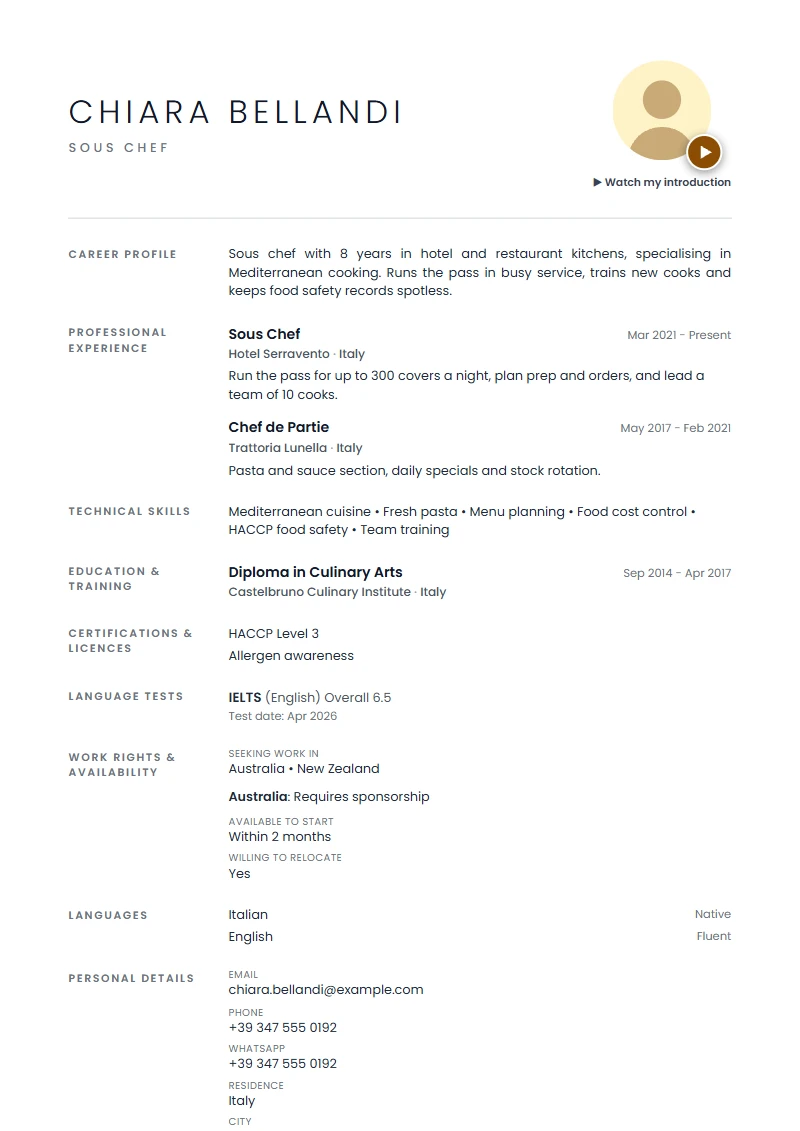
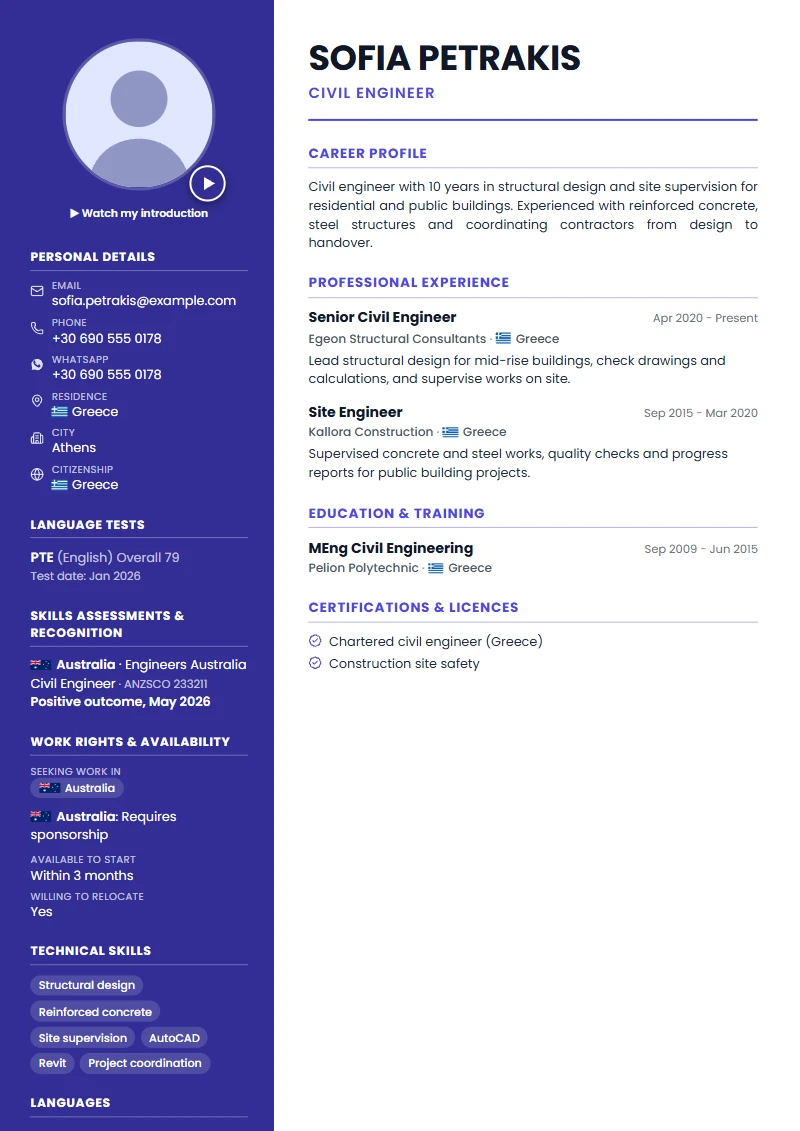
- Your name, phone number and a professional email address on the first page. A LinkedIn link is optional.
- A short personal summary: a few lines about you and what you can offer, written for this job.
- Your skills: job-specific skills (for example, heavy equipment operation) and general skills (for example, teamwork and communication).
- Your work history, most recent job first: job title, employer, when you worked there and what you did.
- If an overseas employer is not well known, add one short line about the company (what it does and how big it is).
- Your education and qualifications, most recent first: the course, the school or training provider, and when you finished.
- Licences and certificates, such as a driver licence, White Card and first aid certificate, with the expiry date of each.
What to leave out
Why: Australian workplace law protects job applicants from being refused a job because of attributes such as age, marital status, religion, race, national extraction and others. Leaving these details out is good practice, so employers can focus on your skills.
- A photo. Government job-search advice says a photo can distract from your skills and experience, and can be hard for automatic resume scanners to read.
- Personal details that are not relevant to the job, such as date of birth, gender, marital status, family members, religion and political views. One government employer tells applicants to leave these out.
Referees
- Include at least two referees who can support your application.
- Choose people who supervised you, from paid work, work experience or volunteering.
- Always ask your referees first, and check their contact details.
- If you worked in a family business, try to find a referee who is not a relative.
- Some employers only ask for referees later in the process.
Your work rights (general information only)
Employers hiring from overseas want to know if you can work in Australia. Your visa may limit the type of work you can do, or your hours. You can check your visa details and conditions online with VEVO, and VEVO can also email your visa details to an employer.
Visa holders and migrant workers have the same workplace rights and protections as all other employees in Australia.
Never pay an employer for a job or for visa sponsorship. The Fair Work Ombudsman says asking for or paying money for visa sponsorship, and cashback schemes, are illegal.
CV tip: Add one short, true line near the top, such as "Work rights: [your current status]". This is common practice, not a rule.
Skills assessment, registration and licences
Some skilled visas need a skills assessment, and others may ask for one. It comes from the assessing authority for your occupation, for example Trades Recognition Australia (TRA) for many trades, VETASSESS for many other occupations, Engineers Australia for engineers and ANMAC for nurses. The official list shows the right body for your job.
- Electricians, plumbers and air-conditioning and refrigeration mechanics applying for permanent migration go through TRA's Offshore Skills Assessment Program. The result can lead to a provisional licence from a state or territory licensing regulator, which lets you work under supervision while you finish gap training.
- Nurses: to work as a nurse you need registration with the Nursing and Midwifery Board of Australia (NMBA). This is separate from the ANMAC skills assessment for migration, and success in one does not guarantee the other.
- Construction sites: you need a construction induction card (White Card) before you start work on a construction site. White Cards are recognised Australia-wide.
- Trade licences are issued by the licensing regulator in each state or territory, so check the one where you want to work.
CV tip: If you have a skills assessment, show it clearly, for example "Skills assessment: [assessing body], [year]". Only write what is true, and write "in progress" if you have applied but have no result yet.
English test results
If you have taken an English test, list the test name, your overall result and the date.
The English tests accepted for Australian visas changed on 7 August 2025. Check the Home Affairs website for the current rules before you book a test.
Tailor it to each job, then check it
- Use the same keywords as the job ad, and put your most relevant skills and qualifications near the top.
- Take out anything that is not relevant to this job.
- Keep the layout simple, professional and easy to read.
- Make sure everything is true and correct.
- Check for spelling and grammar mistakes, and ask someone you trust to read it.
- Save it as PDF or DOCX.