 Build AI CV
What a German job application includes
Send copies of your documents and keep the originals. Write each application for the job and the company, and follow what the job ad asks for.
- A cover letter (Anschreiben).
- A CV (Lebenslauf).
- Certificates (Zeugnisse): copies of your qualifications, training and work references.
- A cover page (Deckblatt) is optional. It can help, but you do not need one.
The German CV format
- Write it as a table: dates on the left, details on the right.
- Start with the most recent job or training, then go back in time.
- Use at most 2 A4 pages.
- Usual sections: personal details, work experience, training or studies, further training, language skills and other skills.
- For each job, give 3 to 5 bullet points with real tasks.
Photo and personal details
A photo is no longer required, but it is still usual in many sectors. EURES says a friendly photo with a neutral background is still part of a German job application. If you use one, make it professional. Do not use a phone selfie or a passport photo.
The Federal Employment Agency lists your name, address, phone number, email address, and date and place of birth as personal details. Details about your family and your nationality are voluntary.
The General Equal Treatment Act (AGG) protects job applicants from discrimination because of race or ethnic origin, gender, religion or belief, disability, age or sexual identity.
Signature and date: optional
EURES suggests that you sign and date your CV. The Federal Employment Agency says it is not strictly necessary, but it can show that your CV is up to date. You can choose.
Language levels
Language skills in Germany are measured with the Common European Framework of Reference (CEFR). It has six levels: A1 and A2 (basic user), B1 and B2 (independent user), C1 and C2 (proficient user).
Many companies expect at least basic German. English alone is often not enough. For some jobs set by law, such as nursing, German is a must.
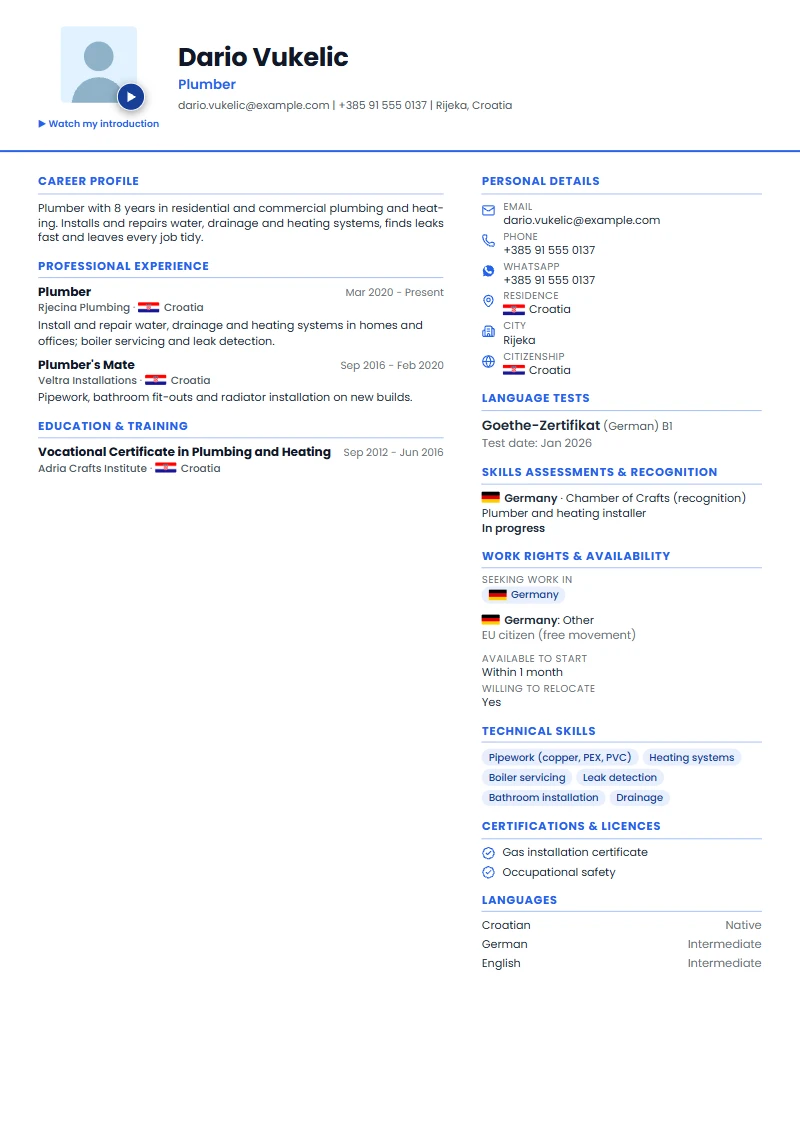
CV tip: Write each language with its level and any certificate, for example "German: B1 (Goethe-Zertifikat B1)" or "English: C1".
Recognition of your qualification (Anerkennung)
Who decides? A "competent authority". For many jobs this is a chamber: for crafts often a chamber of crafts and trades, and for industry and commerce jobs IHK FOSA, which works for the Chambers of Industry and Commerce. The Recognition Finder on the Anerkennung in Deutschland website shows what you need to do and which office to contact.
- Germany has more than 400 regulated professions, for example doctor, nurse specialist, educator, architect and teacher. You may not work in these jobs without recognition.
- Many jobs are not regulated, including about 330 dual training occupations such as motor vehicle mechatronics technician. Recognition is not required to work in them, but it can still help your career.
- If you come from outside the EU, the EEA or Switzerland and have a vocational qualification, you usually need recognition to get a visa.
- Employed or self-employed can make a difference. For example, a plumber who wants to work for a company is treated differently from one who wants to run their own business. To be self-employed in this trade, you must be entered in the crafts register (Handwerksrolle).
CV tip: Write your original qualification, then the German equivalent and your recognition status, for example "Plumber (trade certificate, [country]). Recognition: application submitted".
Cover letter and sending your application
- Cover letter: no more than one A4 page. Say why you want this job at this company, and why you are suitable.
- Write to a named person if you can. You can often phone the company and ask who to write to.
- By email: put all your documents into one PDF file. EURES suggests keeping it under 2 MB.
- Online forms: upload the documents as separate PDF files if the form asks for that.
- Small businesses: have your qualifications and work references translated into German.
Work references (Arbeitszeugnis)
In Germany, the law gives every employee the right to a written reference (Zeugnis) when a job ends. Certificates and references are a normal part of a German application.
CV tip: If your past employers wrote reference letters, add copies to your application, with a German translation for small businesses.
Elsewhere in Europe
- The Europass CV is a free CV format from the European Commission. It is available in 31 languages and is familiar to employers and education institutions.
- EU citizens generally do not need a work permit to work in another EU country.
- CV habits differ from country to country. EURES has a page on living and working conditions for each of 31 European countries.
Visas for Germany (names and links only)
People from outside the EU usually need a visa to take up a job in Germany. You apply at the German embassy in your country.
There are different routes, for example: a visa for a job offer, a visa based on your work experience, the Opportunity Card (Chancenkarte) to come and look for a job, and the EU Blue Card for university graduates.
We do not list requirements or salary levels here, because they change. Check the official websites below.