 Build AI CV
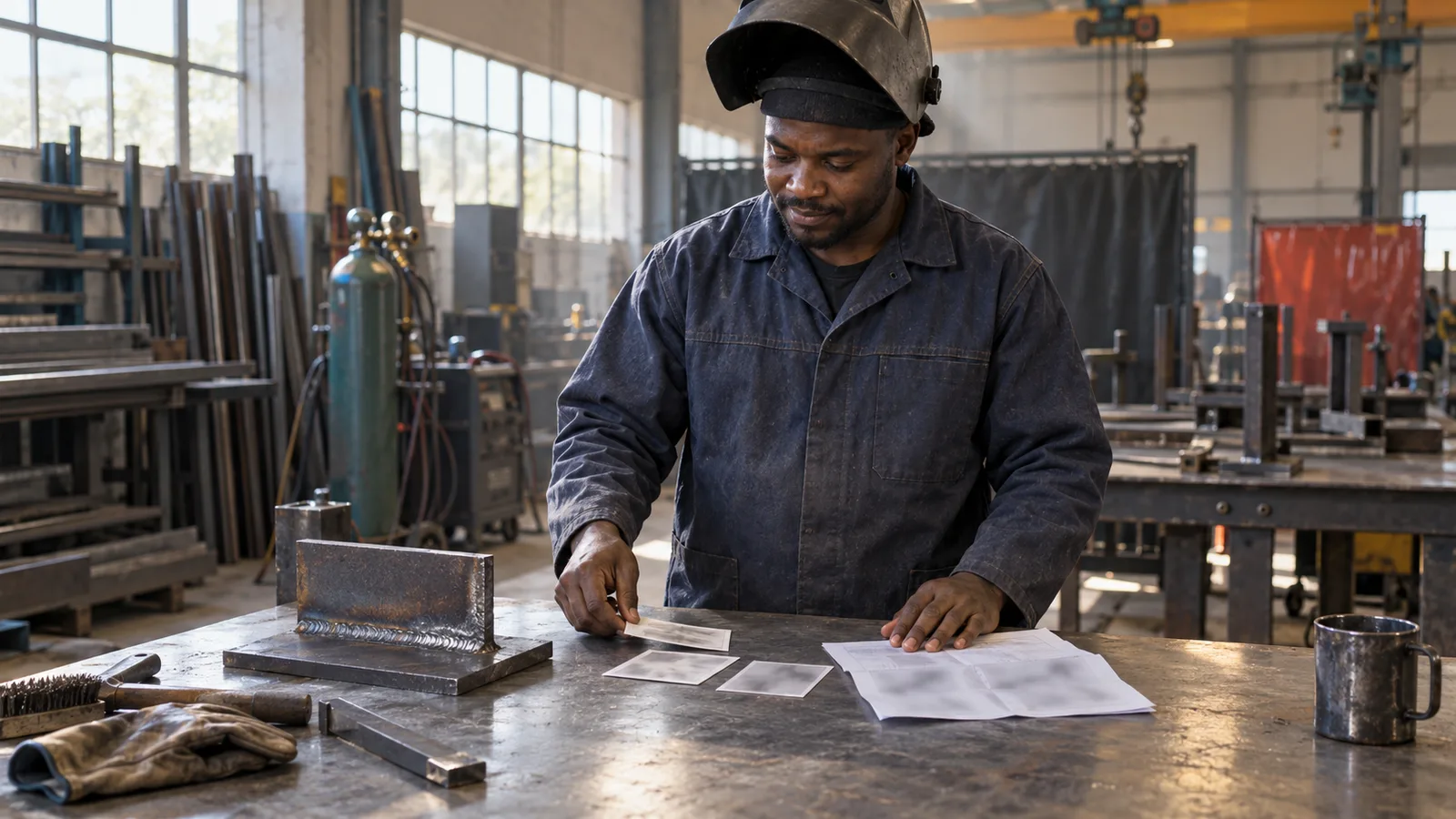
If your boilermaker resume says 'welding and fabrication' and little else, it reads like every other one in the pile, and a supervisor with a shutdown to crew has no reason to call you first. What gets you shortlisted is detail: which processes, which positions, what material and thickness, which tickets are current and what you actually built. Below you'll see how to set out each of those, with example lines you can adapt, a table for your processes and a checklist to run before you apply.
This is written mainly for boilermakers and fabricators applying for jobs in Australia, where the document is usually called a resume. The same approach works for a boilermaker CV anywhere: prove the trade first, then show the work.
What the person hiring wants to know first
Most boilermaker ads are read by someone who knows the trade: a workshop supervisor, a leading hand or a recruiter who fills the same roles month after month. They are working through a short list in their head, and they want the answers near the top of page one.
- Are you trade qualified, and where did you qualify?
- Which welding processes do you use every week, and in which positions?
- What kind of work have you done: structural steel, pressure pipe, tanks, mining equipment, heavy plate repair, stainless or aluminium?
- Can you read drawings and mark out without someone standing beside you?
- Which site tickets and licences do you hold, and are they current?
- Can you work the roster: day shift, night shift, shutdowns or fly-in fly-out?
If your resume answers those six questions in the top half of the first page, the rest only has to back them up.
Put your trade qualification and tickets near the top
Your trade qualification
Write the full name of the qualification exactly as it is printed on your certificate, with the year and the country. In Australia that might be a Certificate III in Engineering (Fabrication Trade). If you trained in another country, give the original name, a plain English description and the length of the apprenticeship, for example 'four-year apprenticeship in metal fabrication and welding'.
If your trade has been formally assessed for Australia, say so in one line with the outcome and the date. A separate article explains where a skills assessment belongs on your resume.
Tickets, licences and weld tests
Give tickets their own section. For each one, write its name, who issued it, the number if it has one, and the expiry date. A boilermaker's list often includes items like these, but list only what you really hold:
- a general construction induction card (the White Card in Australia)
- working at heights and confined space entry training
- high risk work licences, such as dogging, rigging, forklift or elevating work platform
- welder qualification or weld test certificates, with the process, position, material and the standard named on the certificate (for example AS/NZS 1554 or ISO 9606)
- first aid, gas testing or fire watch training
- a driver's licence, with the class
Site and state rules differ, and they change. Check what a job needs in the ad and on the regulator's website for the state you will work in. Do not copy another worker's list.
Expired tickets and ones in progress
Never leave an expired ticket looking current. Write 'expired, renewal booked' with the dates, or leave it off. For training you have started, write 'in progress' with the expected finish date. Tickets are checked before anyone gets through the gate, so an honest line costs you nothing and a wrong one can cost you the job.
Name your processes, positions and materials
'Welding' covers too much. A reader wants to know whether you can run flux-cored wire on heavy structural plate, TIG a stainless pipe root, or both. Say it plainly.
| Detail | Vague line | Clear line |
|---|---|---|
| Process | MIG and stick welding | Daily FCAW and GMAW on structural steel; MMAW for site repairs |
| Position | All positions | Flat, horizontal, vertical-up and overhead; pipe welded in fixed positions |
| Material and thickness | Various metals | Carbon steel plate from 6 mm to 40 mm; some stainless sheet |
| Drawings | Can read drawings | Marks out and fabricates from workshop drawings without supervision |
| Checking your work | Quality focused | Welds visually inspected and ultrasonically tested by an independent inspector |
Use the names in the job ad. If the ad says FCAW, write FCAW, and add the everyday name once in brackets if you like. Then list what you do around the weld: oxy and plasma cutting, air-arc gouging, grinding, rolling, pressing, fit-up, tack-up and slinging loads for an overhead crane.
Only claim a process or position you could demonstrate tomorrow. Some employers ask for a practical weld test before an offer, and that is where a stretched line shows.
Describe what you built, not only your duties
Duty lists sound the same on every resume. Projects do not. For each job, keep two or three duty lines and then add the work itself.
A simple pattern for each line
Say what you made or repaired, the material and size, the process, how it was checked, and the result. You will not have all five every time. Three is enough.
Example lines
Example (a fictional worker, for illustration only):
- Fabricated and welded structural beams and columns for a two-storey warehouse from workshop drawings, using FCAW on plate up to 25 mm.
- Rebuilt worn excavator buckets and truck trays during planned shutdowns: air-arc gouging, fitting wear plate and hardfacing.
- Fitted and welded carbon steel pipe spools for a water treatment plant; welds passed visual and radiographic inspection.
- Marked out, rolled and tacked tank shells from 10 mm plate, working in a crew of four.
- Trained two apprentices in safe grinding, tack-up and reading weld symbols.
Notice what is missing: no client drawings, no confidential site details and no invented numbers. If you do not know a figure, leave it out. A plain true line is stronger than an impressive one you cannot explain at interview.
Shutdowns, contracts and FIFO work
Short contracts can make a resume look jumpy. Group them. Under one heading such as 'Shutdown and contract work, 2023 to 2025', give each job a single line with the type of site, the task and the length of the contract. Add the rosters you have worked if the ad mentions one. This shows steady work instead of a string of short jobs.
Build your boilermaker resume in 6 steps
- Read the ad and underline the processes, materials, tickets and roster it names.
- Write a three-line profile: your trade, your years in it, your main type of work and your strongest process. Example: 'Trade-qualified boilermaker with nine years in structural and mining fabrication. Daily FCAW and MMAW on plate up to 40 mm. Current working at heights, confined space and dogging tickets.'
- List tickets and licences with numbers and expiry dates.
- Add a short skills block: processes, positions, materials, machines and drawing skills.
- Write each job with two or three duties and two or three project lines.
- Finish with education, referees who have agreed to be contacted, and your availability.
For jobs in Australia, aim for about two pages and leave off a photo and personal details such as age and marital status. The CV for Australia guide covers the layout in more detail.
Tools that can make this quicker
You can do all of this in any word processor. A CV builder simply takes care of the layout so you can concentrate on the wording.
In Build AI CV, licences and certificates with numbers or expiry dates have their own step in the editor. The Technical / Trades template in Build AI CV shows skills, licences, tools and brand experience in a snapshot panel up front; it is a Pro template, so anyone can preview it, but downloading a CV in it needs an active Pro Pass. Classic and ATS Plain are the free templates in Build AI CV, and you can switch templates at any time without retyping.
There is no boilermaker example on the site. The closest is the welder CV example, which is a useful starting point for wording your processes and tickets.
When your notes are ready, you can start in the editor as a guest; a free account is needed to save the CV or download the PDF. Build my CV, it's free
Checklist before you send it
- Trade qualification with year and country on page one
- Every ticket with an expiry date, and none out of date
- Processes named the way the ad names them
- Positions, materials and thicknesses stated
- At least two project lines for each recent job
- Work rights stated in one truthful line if you are applying from overseas
- Saved as a PDF with your name and the word boilermaker in the file name
- Phone number with country code, and an email address you check daily
On work rights, write only your real status in plain words. This article is general resume advice, not immigration advice, so check the official government website for your own situation.
Frequently asked questions
Should I write boilermaker or fabricator on my resume?
Use the title in the ad if it truly describes your work, and keep your official job title in brackets, for example 'Boilermaker (employed as Welder-Fabricator)'. Titles for this trade change between countries, so a short explanation helps.
How long should a boilermaker resume be?
About two pages suits most Australian applications. If you have many short contracts, group them so the detail goes to your most recent and most relevant work.
Do I need to list every ticket I hold?
List the ones the ad asks for first, then others that matter on that kind of site. Old or unrelated tickets can share a single line or be left off.
Can I add photos of my welds or finished jobs?
Yes, if you had permission to take them and they show no client drawings, site names or other people's faces. Two or three clear photos of finished work, each with a caption naming the process and material, are enough.
What if my welding certificates have expired?
Say so honestly and add what you are doing about it, such as a booked retest. Some employers run their own weld test anyway, so state that you are available for one.


